Penny Stock Technical Analysis: Complete Guide 2026
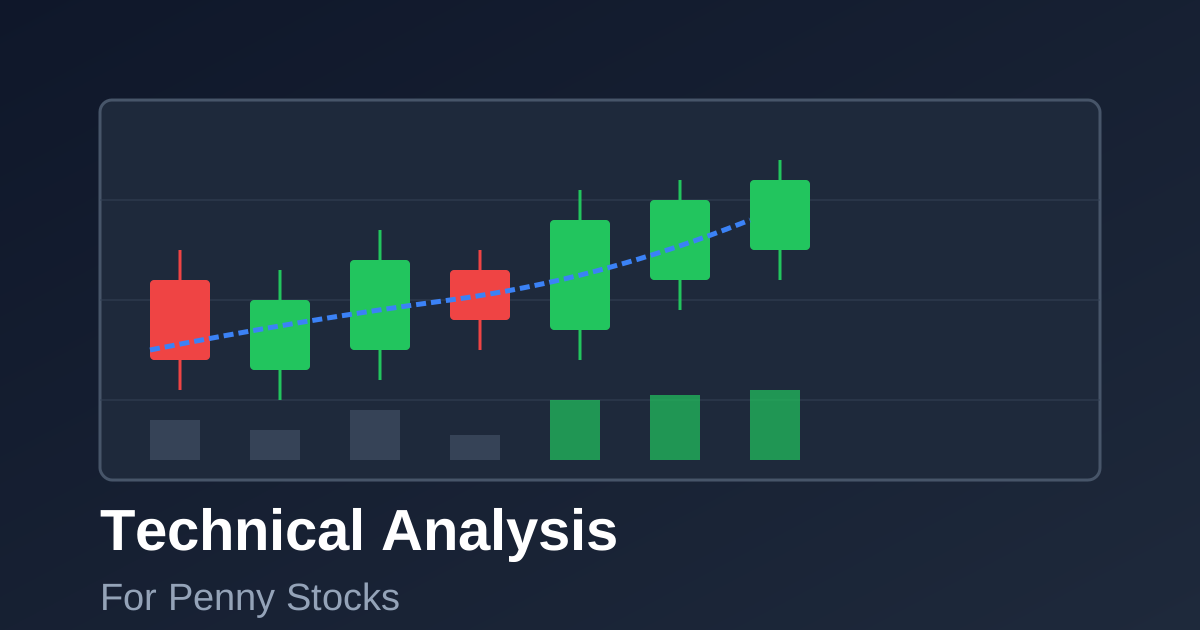
Technical analysis for penny stocks is fundamentally different from analyzing large-cap stocks. The extreme volatility, lower liquidity, and susceptibility to manipulation mean that many traditional technical indicators produce false signals or become completely unreliable. Yet certain technical patterns and methods work remarkably well for penny stocks when properly adapted to the unique characteristics of low-priced, thinly-traded securities.
Professional penny stock traders who consistently profit develop specialized technical analysis skills tailored specifically to small-cap price action. They know which indicators to ignore, which patterns have the highest probability of success, and how to combine technical signals with fundamental catalysts for maximum edge. This comprehensive guide reveals the exact technical analysis methods that actually work for penny stocks in 2025, based on real-world trading experience and statistical analysis of thousands of penny stock charts.
Featured Penny Stock Opportunity
Offshore Namibia Oil & Gas Exploration
Stamper Oil & Gas (STMP)
Asymmetric Opportunity: Trading at ~$10M USD with risked NAV of ~$255M and probability-weighted upside suggesting 25x potential
Industry-Leading Success: 14 of 16 exploration wells successful since 2022 in Namibia. Supermajors committing billions
Carried Interest Portfolio: Exposure to basin-opening wells without proportionate capital investment. No dilution strategy
2025-2026 Catalysts: Venus FID expected, Chevron Walvis Basin wells, new seismic on PEL 106, and multiple farm-out opportunities
⚠️ High-risk investment. Oil & gas exploration carries substantial risk including total loss of capital. Not investment advice. Conduct independent due diligence.
Why Traditional Technical Analysis Fails for Penny Stocks
Most retail traders apply large-cap technical analysis methods to penny stocks and wonder why they lose money consistently. The fundamental problem is that penny stocks violate many assumptions underlying traditional technical analysis.
Traditional technical analysis assumes relatively efficient markets with sufficient liquidity that large orders don't dramatically distort price action. Penny stocks often trade only 100,000-500,000 shares per day, meaning a single $10,000 order can create a 10% price spike or crash. This low liquidity makes penny stocks vulnerable to manipulation and creates false breakouts that trap retail traders.
Many classic indicators like MACD, RSI, and Bollinger Bands produce constant false signals in penny stocks due to extreme volatility and low volume. A penny stock can show "oversold" RSI readings for weeks while continuing to drop 80%, or show "overbought" readings while exploding 500% higher. Traditional support and resistance levels are routinely violated with no follow-through.
The solution isn't to abandon technical analysis—it's to adapt your approach specifically for penny stock characteristics. Focus on high-probability patterns that account for volatility and manipulation, use volume analysis as your primary tool, and always combine technical signals with fundamental catalysts. Learn more about identifying fundamental catalysts in our comprehensive guide to penny stock catalysts.
The Foundation: Volume Analysis
Volume is by far the most reliable technical indicator for penny stocks. Unlike price, which is easily manipulated, sustained volume increases require real capital and typically indicate institutional accumulation or genuine retail interest. Every profitable penny stock technical setup begins with proper volume analysis.
Relative Volume Patterns
Compare current volume to historical averages, not absolute numbers. A stock trading 2-3x its average daily volume is showing genuine interest; 10x average volume often marks the beginning of major moves. Watch for volume explosions on green days versus red days—consistent higher volume on up days versus down days indicates accumulation, even if price is consolidating.
Volume Dry-Ups
Extremely low volume after a significant decline often precedes reversals. When a penny stock drops 60-80% and then trades at 25% of normal volume for several days, it indicates all weak hands have been shaken out. The next catalyst often produces explosive moves because there's no supply left—everyone who wanted to sell has already sold.
Climax Volume
Massive volume spikes (10-50x normal) that don't produce corresponding price gains often mark exhaustion. When a penny stock trades 20x normal volume but closes near the day's lows, it shows that even massive demand couldn't drive prices higher—distribution is occurring. These are often excellent short-term short opportunities or signals to avoid buying.
Accumulation/Distribution Volume Pattern
The single most powerful volume pattern for penny stocks: gradually increasing volume over 2-4 weeks while price consolidates in a tight range. This indicates informed accumulation before a catalyst. Calculate the average daily volume for 30 days, then watch for consecutive weeks where average volume increases by 25-50% each week while price stays within a 15-20% range.
High-Probability Chart Patterns for Penny Stocks
Not all chart patterns work equally well for penny stocks. Focus on these specific patterns that have demonstrated statistical edge when trading low-priced stocks:
The Low Float Squeeze Setup
This is the single highest-probability technical setup for explosive penny stock moves. Requirements: float under 20 million shares, short interest above 15% of float, stock in clear consolidation pattern near 52-week lows, and upcoming fundamental catalyst. When these factors combine, any positive catalyst forces short covering that creates explosive vertical moves. The technical trigger is a daily close above the consolidation range on 3x+ volume.
The Cup and Handle (Modified for Penny Stocks)
The classic cup and handle works for penny stocks but requires modifications. The "cup" should form over 4-12 weeks (not months), the handle should form in 1-2 weeks with declining volume, and the breakout must occur on 3-5x average volume. Unlike large caps, penny stock cups don't need to be U-shaped—V-shaped bottoms work fine due to higher volatility. The critical factor is volume declining into the handle and exploding on the breakout.
The Fallen Angel Pattern
A stock that previously traded at $3-5+ declines to $0.50-1.00, consolidates for 3-6 months, then shows signs of a new uptrend. These former highfliers often attract previous shareholders who want to recover losses, creating supply. However, once that supply is absorbed (visible in volume drying up), the stock can move explosively back toward previous levels. The technical setup: consolidation at 52-week lows for 3+ months, gradually increasing volume, and higher lows pattern forming. Entry is the break above the consolidation range on strong volume.
The Volatility Contraction Pattern
Penny stocks are volatile by nature, so when volatility contracts dramatically, it often precedes explosive expansions. Identify this pattern by measuring the trading range (high minus low) for each day, then calculating the 10-day average trading range. When the current 10-day average is 50% or less of the 90-day average trading range, and volume is also contracting, the stock is coiling for a move. The direction is determined by the breakout direction—wait for price to break the consolidation range on increasing volume before entering.
Support and Resistance for Penny Stocks
Support and resistance levels work differently for penny stocks than large caps. Low liquidity means levels are often violated temporarily before ultimately holding, and psychological round numbers have outsized importance.
Psychological Price Levels
Round numbers like $0.50, $1.00, $2.00, etc. act as powerful support and resistance for penny stocks because retail traders cluster orders at these levels. Also pay attention to previous pump highs—stocks that were pumped to $3.00 will often face massive resistance when approaching that level again as previous bag holders sell to break even. Learn to identify pump and dump schemes from our guide to avoiding pump and dump scams.
Volume-Weighted Support/Resistance
Unlike large caps where every price level has significant volume, penny stocks often have specific price ranges where the majority of volume transacted. These volume clusters create strong support/resistance. Use volume-by-price indicators (available on most charting platforms) to identify these zones. When a stock trades 40% of its total volume at $0.70-0.80, that range will act as significant support/resistance when revisited.
The 50% Retracement Level
After significant moves, penny stocks commonly retrace exactly 50% before resuming the trend. If a stock moves from $0.50 to $2.50 (+400%), a pullback to $1.50 (50% retracement) offers an excellent entry point for the continuation move. This pattern repeats with remarkable consistency in penny stocks, likely because retail traders are attracted to these mathematical levels.
Moving Averages That Actually Work
Most moving averages are useless for penny stocks due to volatility and price gaps. However, certain specific moving averages provide valuable information when used correctly:
The 20-Day Simple Moving Average (SMA)
This is the single most useful moving average for penny stocks. It adapts quickly enough to catch trends but isn't so fast that it whipsaws constantly. Use it primarily to define trend direction: when price is consistently above the 20-day SMA and the SMA is rising, the trend is bullish. When both conditions are met, only take long positions. When price is below a declining 20-day SMA, avoid longs or consider shorts.
The 200-Day SMA (For Context Only)
Don't use the 200-day SMA for trading decisions, but note its location for context. Penny stocks trading below their 200-day SMA are in long-term downtrends; moves above the 200-day SMA often produce significant momentum as algorithms and institutions use this signal. The first cross above the 200-day SMA after extended periods below it is particularly powerful for penny stocks.
Avoid Short-Term EMAs
Many traders use 9-day or 12-day exponential moving averages, but these are too sensitive for penny stock volatility. They produce constant false crossover signals that lose money. Stick with the 20-day SMA for penny stocks—simplicity works better than complexity.
Momentum Indicators Adapted for Penny Stocks
Traditional momentum oscillators like RSI and MACD mostly fail for penny stocks, but modified versions and alternative indicators provide genuine edge:
Modified RSI Strategy
Standard RSI (14-period) is unreliable for penny stocks, but a modified approach works: use a 9-period RSI with extreme thresholds (below 20 for oversold, above 80 for overbought) and only pay attention when combined with volume confirmation. An RSI below 20 on declining volume after a significant drop suggests capitulation; RSI above 80 on exploding volume confirms momentum. Ignore RSI signals in the 30-70 range entirely for penny stocks.
Rate of Change (ROC) Indicator
ROC measures percentage change over a specified period and works better than RSI for penny stocks. Use a 12-period ROC and watch for: extreme negative readings (below -40%) followed by a turn positive while price is still near lows (reversal signal), and ROC crossing above zero after extended negative periods (trend change confirmation). ROC works because it focuses on the pace of price change rather than absolute levels, which is more relevant for volatile penny stocks.
On-Balance Volume (OBV)
OBV is one of the few indicators that works reliably for penny stocks. It cumulates volume on up days and subtracts volume on down days, creating a volume-based trend line. The key signal: when OBV makes higher highs and higher lows while price is consolidating or even declining slightly, it indicates professional accumulation. This divergence often precedes significant moves by 2-4 weeks.
Gap Trading Strategies
Penny stocks gap up or down constantly due to low liquidity and overnight news. Understanding gap behavior is essential for profitable penny stock trading:
Gap-and-Go Pattern
When a penny stock gaps up 15-30% on news and then continues higher after the open (rather than immediately fading), it indicates genuine strength. The pattern: gap up at open, brief consolidation for 15-30 minutes, then move higher on increasing volume. This is one of the highest-probability day trading setups. Entry is the break above the first 30-minute consolidation range.
Gap Fill Trading
Penny stocks have a strong tendency to fill gaps, especially gaps down on light volume. When a stock gaps down 10-20% on low volume and no significant news, there's a high probability of gap fill within 3-5 trading days. This creates a mean-reversion trade opportunity: enter near the gap-down low with a tight stop, targeting the gap fill. Learn more about trading around gaps and volatility in our guide to day trading penny stocks.
Partial Gap Fills
After gaps up on significant news, watch for 50% gap retracements as entry points. If a stock closes at $0.60, gaps up to $1.20 at open, then pulls back to $0.90 (50% retracement of the gap), this often provides an excellent entry for continuation to new highs. The 50% retracement allows late buyers to enter while shaking out early sellers.
Breakout Trading: The Core Penny Stock Strategy
Breakout trading is the single most profitable technical strategy for penny stocks when executed properly. The key is identifying genuine breakouts versus false breakouts that immediately reverse:
Characteristics of Genuine Breakouts
- Volume on breakout day is at least 3x the 30-day average
- Price closes in top 25% of the day's range (strong close)
- Consolidation before breakout lasted at least 3 weeks
- Fundamental catalyst accompanies the technical breakout
- Previous resistance level is clearly defined and significant
- Low float (under 50M shares) amplifies the breakout
Entry Timing for Breakouts
Never chase breakouts at the moment they occur—wait for confirmation. The best approach: note the breakout level, wait for a 1-3 day pullback toward the breakout level (which now becomes support), and enter when price bounces off the new support with increasing volume. This patience dramatically improves your risk-reward ratio and reduces false breakout losses.
Position Sizing on Breakouts
Use a scaling approach: enter with 30-40% of your intended position at the initial breakout confirmation, add another 30-40% if the breakout holds and extends on day 2-3, and add final 20-30% only if the stock shows exceptional strength (new highs on increasing volume). This approach allows you to cut losses quickly if the breakout fails while building full positions on genuine moves. Apply proper position sizing from our risk management guide for penny stocks.
Combining Technical Analysis with Fundamental Catalysts
The highest-probability penny stock trades combine technical setups with fundamental catalysts. Technical analysis alone misses many opportunities, and fundamental analysis alone often leads to early entries where you suffer drawdowns before the move begins.
The ideal setup: a stock with an upcoming fundamental catalyst (FDA decision, earnings release, resource estimate, etc.) trading in a consolidation pattern near support with increasing volume. The technical setup tells you when to enter; the fundamental catalyst tells you why the stock should move. This combination produces the highest win rates and best risk-reward ratios.
Typical timeline: identify the fundamental catalyst 4-8 weeks in advance, monitor for technical setup development over the following weeks, and enter when technical setup confirms 1-3 weeks before the catalyst date. This approach captures the anticipatory move before the catalyst while avoiding excessive holding time. Learn more about identifying and trading catalysts in our complete penny stock catalysts guide.
Risk Management for Technical Traders
Even with perfect technical analysis, risk management determines whether you profit long-term. Every technical trade must have predefined stop loss and profit targets before entry:
Stop Loss Placement
For breakout trades, place stops 10-15% below the breakout level or just below the consolidation range. For reversal trades at support, place stops 15-20% below the support level. For pullback entries in uptrends, place stops just below the 20-day moving average or recent swing low. Always use percentage-based stops for penny stocks, never fixed dollar amounts, because volatility varies dramatically between different penny stocks.
Profit Targets
Set initial profit targets at 2-3x your risk (if risking 15%, target 30-45% gain minimum). When price reaches your initial target, take 50% of your position off and move your stop to breakeven on the remainder. Let the remainder run with a trailing stop. This approach guarantees profits on winning trades while allowing occasional big winners to develop.
Time Stops
If a technical setup doesn't work within 5-10 trading days, exit even if your price stop hasn't been hit. The failed timing suggests your analysis was incorrect, and your capital is better deployed in new opportunities. Time stops are particularly important for penny stocks because catalyst timing can shift, making previously valid setups obsolete.
Common Technical Analysis Mistakes
Even experienced traders make these technical analysis mistakes repeatedly when trading penny stocks:
Using too many indicators. The more indicators you add, the more confused you become. Penny stock technical analysis should be simple: focus on price action, volume, and one or two momentum indicators maximum. If your chart looks like a rainbow with 10 different indicators, you're overcomplicating.
Ignoring context. A bullish technical pattern in a stock with terrible fundamentals and dilution issues will fail. Always understand the fundamental context before trading technical patterns. A perfect cup and handle means nothing if the company just announced toxic financing.
Trading against the trend. The vast majority of penny stock profits come from trending moves, not reversals. When a stock is in a clear downtrend (below declining 20-day SMA, making lower lows), don't try to catch the exact bottom with reversal trades. Wait for evidence of trend change before entering longs.
Analysis paralysis. Perfect analysis doesn't exist. When you have 70-80% conviction based on multiple confirming factors (volume, pattern, catalyst, etc.), take the trade with appropriate position size and stop loss. Waiting for 100% certainty means you'll miss most opportunities. Learn when to act decisively in our comprehensive guide to how to trade penny stocks.
Conclusion: Develop Your Technical Edge
Technical analysis for penny stocks is both an art and a science. The patterns and indicators outlined in this guide provide a framework, but true mastery comes from chart time—spending hours studying penny stock charts, noting which patterns worked and which failed, and developing an intuitive feel for price action.
Start by focusing on one or two high-probability patterns from this guide. Master the low float squeeze setup or the cup and handle pattern before moving to more complex analysis. Track every trade in a journal, noting which technical factors were present and whether the trade worked. Over time, you'll discover which patterns align best with your personality and schedule.
Remember that technical analysis is only one component of successful penny stock trading. Combine these technical methods with the fundamental catalyst research from our guide on finding penny stocks before they explode and risk management principles from our complete risk management guide. Understanding what happens during trading halts and how to interpret halt codes will also help you navigate the inevitable volatility that comes with penny stock technical breakouts.
The traders who consistently profit from penny stocks don't have secret indicators or magical chart patterns—they have systematic approaches, disciplined risk management, and the patience to wait for high-probability setups. Master the technical analysis methods in this guide, combine them with fundamental research, and you'll join the small percentage of penny stock traders who actually make money consistently.
Featured Penny Stock Opportunity
Offshore Namibia Oil & Gas Exploration
Stamper Oil & Gas (STMP)
Asymmetric Opportunity: Trading at ~$10M USD with risked NAV of ~$255M and probability-weighted upside suggesting 25x potential
Industry-Leading Success: 14 of 16 exploration wells successful since 2022 in Namibia. Supermajors committing billions
Carried Interest Portfolio: Exposure to basin-opening wells without proportionate capital investment. No dilution strategy
2025-2026 Catalysts: Venus FID expected, Chevron Walvis Basin wells, new seismic on PEL 106, and multiple farm-out opportunities
⚠️ High-risk investment. Oil & gas exploration carries substantial risk including total loss of capital. Not investment advice. Conduct independent due diligence.
Never Miss a Trading Halt
Get instant real-time alerts when stocks under $5 halt or resume trading on NASDAQ, NYSE, TSX & TSXV
View Live Halt Tracker →Continue Learning
Explore more penny stock trading guides

Trading Halts Explained: What Every Trader Should Know
Complete guide to stock trading halts: what they are, why they happen, halt codes (T1, T2, LUDP), and how to trade around them profitably.

Trading Halt Codes Explained: T1, T2, T12, LUDP
Complete guide to stock trading halt codes. Learn what T1, T2, T12, and LUDP mean, how long each lasts, and what they signal for traders.

What Happens When a Stock is Halted? Complete Guide
Learn what happens during a trading halt, how long halts last, if you can sell during a halt, and what to do when your stock is halted.