OTC Stocks vs Penny Stocks: What's the Difference in 2026?
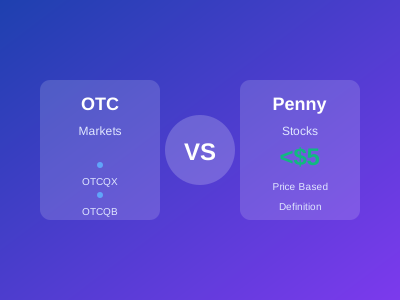
Many traders use the terms 'OTC stocks' and 'penny stocks' interchangeably, but they represent fundamentally different classifications. Understanding this distinction is crucial for making informed investment decisions and managing risk appropriately.
This comprehensive guide will clarify the key differences between OTC stocks and penny stocks, explain how they overlap, and help you determine which opportunities align best with your trading strategy and risk tolerance.
Featured Penny Stock Opportunity
Offshore Namibia Oil & Gas Exploration
Stamper Oil & Gas (STMP)
Asymmetric Opportunity: Trading at ~$10M USD with risked NAV of ~$255M and probability-weighted upside suggesting 25x potential
Industry-Leading Success: 14 of 16 exploration wells successful since 2022 in Namibia. Supermajors committing billions
Carried Interest Portfolio: Exposure to basin-opening wells without proportionate capital investment. No dilution strategy
2025-2026 Catalysts: Venus FID expected, Chevron Walvis Basin wells, new seismic on PEL 106, and multiple farm-out opportunities
⚠️ High-risk investment. Oil & gas exploration carries substantial risk including total loss of capital. Not investment advice. Conduct independent due diligence.
Research OTC & Penny Stocks on OTCXplorer
Access comprehensive data and analytics for over 13,000+ OTC stocks including OTCQX, OTCQB, and Pink Sheet companies. Get AI-powered stock reports, real-time market data, and discover high-potential opportunities.
What Are OTC Stocks?
OTC (Over-The-Counter) stocks are securities that trade through dealer networks rather than centralized exchanges like NASDAQ or NYSE. The term 'OTC' describes WHERE a stock trades, not its price. OTC markets include OTCQX (highest tier), OTCQB (middle tier), and Pink Sheets (lowest tier with minimal requirements).
Companies trade OTC for various reasons: inability to meet major exchange listing requirements, choice to avoid exchange fees and regulatory burdens, international companies seeking US investor access, or companies in financial distress. Understanding OTC markets is essential—learn more in our complete guide to OTC penny stocks vs NASDAQ.
What Are Penny Stocks?
Penny stocks are defined by PRICE—specifically securities trading below per share according to SEC definition. The term 'penny stock' describes WHAT PRICE a stock trades at, regardless of where it trades. Penny stocks can trade on major exchanges (NASDAQ, NYSE) or OTC markets.
A stock on NASDAQ is technically a penny stock. A stock on Pink Sheets is NOT a penny stock by SEC definition, though it trades OTC. This price-based definition means penny stocks represent a price point, not a market location. Learn the fundamentals in our complete guide to what penny stocks are.
The Critical Overlap: OTC Penny Stocks
Most penny stocks trade OTC, and most OTC stocks are penny stocks—this overlap creates confusion. However, the Venn diagram isn't a perfect circle. Exchange-listed penny stocks include established companies that have fallen below , small-cap companies that meet exchange requirements but trade under , and companies uplisting from OTC that haven't yet crossed .
OTC stocks that aren't penny stocks include international companies trading via ADRs above , companies choosing OTC for strategic reasons while maintaining higher prices, and former major exchange stocks above that delisted voluntarily. The intersection creates the highest-risk category: OTC penny stocks combining low price with minimal regulation.
Key Differences in Risk Profile
Exchange-listed penny stocks face rigorous listing requirements including minimum shareholders, bid price maintenance, corporate governance standards, and regular financial disclosure. They offer better liquidity, tighter spreads, real-time price data, and easier short selling. Risks include volatility, low institutional ownership, and potential delisting.
OTC stocks above trade through dealer networks with varying disclosure requirements, may have legitimate business reasons for OTC status, and can offer international exposure. However, they face wider spreads, limited liquidity, and harder short selling. OTC penny stocks combine ALL risks: minimal disclosure requirements, extreme price volatility, high manipulation risk, poor liquidity, and frequent fraud.
Trading Mechanics and Market Access
Exchange penny stocks trade through standard brokers with commissions, real-time quotes, and Level 2 data. They offer easy order execution and straightforward short selling. OTC stocks require brokers with OTC access (not all offer it), commissions typically - per trade, delayed quotes (15-20 minutes), and paid Level 2 data. Pink Sheet access is limited, short selling is difficult, and many discount brokers restrict access.
Learn about the best brokers for penny stock trading in our comprehensive broker comparison guide.
Regulatory Environment and Investor Protection
Exchange penny stocks must file with SEC (10-K, 10-Q, 8-K), face NASDAQ/NYSE compliance monitoring, and have audited financial statements. OTCQX stocks meet high international standards and have verified management. OTCQB stocks have minimum bid price, financial reporting, and management verification. Pink Sheet stocks have NO disclosure requirements, potential dark/limited information, and high fraud risk.
Which Should You Trade?
Start with exchange-listed penny stocks if you're a beginner, want maximum transparency, prioritize liquidity, or plan to use technical analysis and day trade. These offer the best risk/reward balance for new penny stock traders. Consider our guide on how to trade penny stocks for proven strategies.
Consider OTCQX/OTCQB if you have some experience, are comfortable with research, want international exposure, or are willing to accept higher risk for potentially higher rewards. Approach Pink Sheets ONLY if you're very experienced, can conduct deep due diligence, have money you can afford to lose completely, and understand manipulation tactics. Learn to spot scams in our pump and dump guide.
Conclusion: Know What You're Trading
OTC vs penny stock isn't an either/or choice—they're different classification systems. OTC describes where a stock trades; penny stock describes its price. Your risk exposure comes from BOTH factors combined. The safest penny stocks trade on major exchanges with full disclosure. The riskiest are OTC penny stocks on Pink Sheets with zero disclosure requirements. Success requires understanding exactly what you're trading and why those classifications matter for your risk management strategy.
Featured Penny Stock Opportunity
Offshore Namibia Oil & Gas Exploration
Stamper Oil & Gas (STMP)
Asymmetric Opportunity: Trading at ~$10M USD with risked NAV of ~$255M and probability-weighted upside suggesting 25x potential
Industry-Leading Success: 14 of 16 exploration wells successful since 2022 in Namibia. Supermajors committing billions
Carried Interest Portfolio: Exposure to basin-opening wells without proportionate capital investment. No dilution strategy
2025-2026 Catalysts: Venus FID expected, Chevron Walvis Basin wells, new seismic on PEL 106, and multiple farm-out opportunities
⚠️ High-risk investment. Oil & gas exploration carries substantial risk including total loss of capital. Not investment advice. Conduct independent due diligence.
Never Miss a Trading Halt
Get instant real-time alerts when stocks under $5 halt or resume trading on NASDAQ, NYSE, TSX & TSXV
View Live Halt Tracker →Continue Learning
Explore more penny stock trading guides

Canadian Penny Stocks: Complete TSX & TSXV Guide 2025
Trade Canadian penny stocks on TSX and TSXV. Learn about mining stocks, cannabis companies, regulations, and how Canadian exchanges differ from US markets.

OTC Penny Stocks vs NASDAQ: What's the Difference?
Understand the key differences between OTC and NASDAQ penny stocks. Learn about regulation, liquidity, risks, and which is better for your trading strategy.